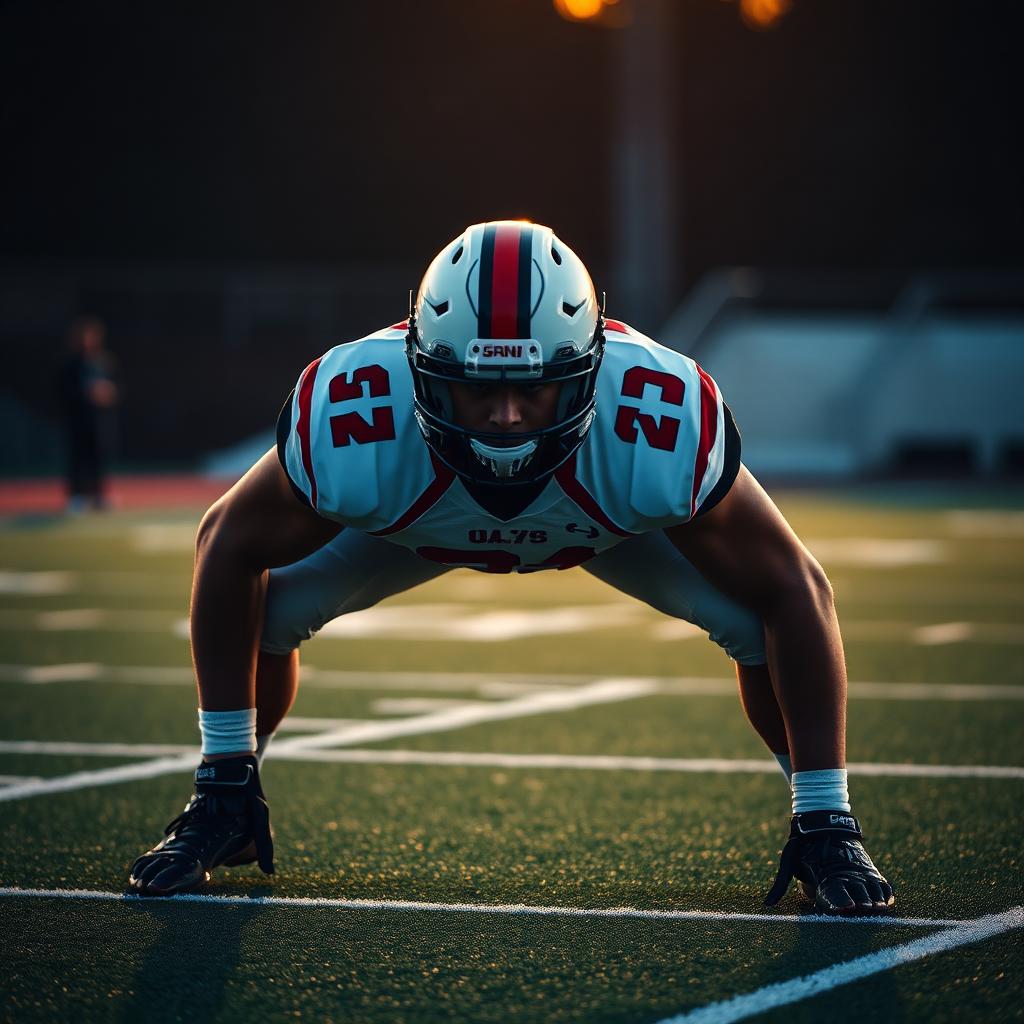
The Defensive End Stance: Building Your Foundation
Every great pass rush starts before the ball is snapped. Here's how to build a stance that gives you leverage, explosion, and balance on every single rep.
Most high school defensive ends never think about their stance. They walk up to the line, drop their hand, and react. That's why most high school defensive ends top out at "pretty good." If you want to play at the next level, your stance is the first thing a college coach is going to evaluate when he pulls up your tape — and it's the easiest thing to fix.
Why your stance matters
Your stance is a loaded spring. Everything about your first step — direction, force, angle, timing — is decided by how you set up before the ball moves. A bad stance leaks energy in three places: out the back (you're not loaded forward), up through the spine (you're too tall), and out the sides (your base is too narrow or too wide). When you uncoil, that leaked energy is gone forever. You can't recover it during the snap. So the stance is not "getting comfortable." It's pre-storing the explosion you're going to need a quarter-second later.
The three-point stance, broken down
Start with your stagger. If you're rushing off the right side of the defense (rushing the left tackle), your right foot is back and your left foot is up. The toe of the back foot lines up roughly with the heel/instep of the front foot. Too much stagger and you can't redirect on a reach block. Not enough and you can't push off into a hard get-off.
Your feet should be about armpit-width apart — not shoulder-width, not wider. Most kids set up way too wide because it "feels strong." It isn't. A wide base locks your hips. A tight base lets you fire your hips forward into the rush.
Drop your down hand on the same side as your back foot. So back foot right, down hand right. Your hand goes down about a fist's length in front of your face mask, weight loaded into the heel of the palm. Not your fingertips — the heel of your palm — so you can drive off it like a piston. Your off-hand sits cocked up by your hip, fingers loose, ready to deliver a punch.
Your hips should be slightly higher than your shoulders. Imagine a tilted line from your shoulders up to your tail. That tilt gives you forward lean — you should already feel like you're falling forward before the ball moves. If you can hold your stance for ten seconds without your front toes getting heavy, you're not loaded enough.
Eyes
Eyes are coached last and they decide everything. Your eyes go to the V of the neck — the spot where the offensive tackle's chest meets his shoulder pads — and they stay there until the ball moves. Not the ball. Not the quarterback. Not the guard. The V of the neck.
Why? Because the tackle's helmet, hands, and ball will all move at the same time. If your eyes are bouncing around, you'll false start mentally and lose your first step. The V doesn't lie. When the tackle's chest starts to rise or fall, the snap is happening.
Common mistakes
The first mistake is being too tall. Tall stances feel athletic to the player but they look slow on film. If your hips are above your shoulders by more than a few degrees, drop the hips.
The second is the "happy feet" pre-snap. If you're tapping or shuffling, you're stealing energy from your get-off and you're tipping the snap count. Be a statue.
The third is gripping the grass. The down hand is a tripod, not a claw. If your knuckles are white before the snap, your shoulders are tight and you're going to come out of the stance high.
The fourth is staring at the ball. The ball is too small a visual target. The V of the neck is bigger, it moves with the tackle, and it gives you a quarter-tick earlier read.
A drill you can do today
Get into your stance against a wall. Hand down, hips loaded, feet right. Have someone yell "go" at a random interval between three and eight seconds. Your job is to fire your back foot first, drive your hand through the wall like you're delivering a punch, and finish three full steps before you straighten up. Reset. Do ten on each side. Do this every day for two weeks and your first step at practice will look different.
The bottom line
Coaches at every level — high school varsity, college, pro — agree on this one thing: you cannot rush the passer at a high level out of a bad stance. The good news is the stance is free. It doesn't cost you a pound of muscle, a tenth on the forty, or an inch of arm length. It's a habit. Build it now, before you have anything to fix, and you'll be ahead of every D-end you line up across from this fall.