Film Study: How to Watch Yourself Like a Coach
Watching film is not watching your highlights. It's hunting for what went wrong. Here's the system that turns Sunday film into Friday performance.
Most high school football players think watching film means scrolling through their highlight reel on Hudl on Sunday night and feeling good about themselves. That's not film study. That's a feel-good ritual. Real film study is uncomfortable, repetitive, and unglamorous, and it is the single biggest difference between players who plateau in high school and players who keep developing in college.
The mindset shift
When a college coach watches your film, he is not looking for what you did well. He is looking for what you did wrong, repeatedly, in the same situations. Pattern losses. Bad habits. Reps where you should have made a play and didn't.
You have to watch your own film the same way. Forget the sacks. Forget the highlight reps. Find the snaps where you got reach-blocked, where you got cut, where you lost a one-on-one, where you missed a tackle, where you got fooled by play action. Those are your reps. Those are the ones that show you what to fix.
A film-study session, step by step
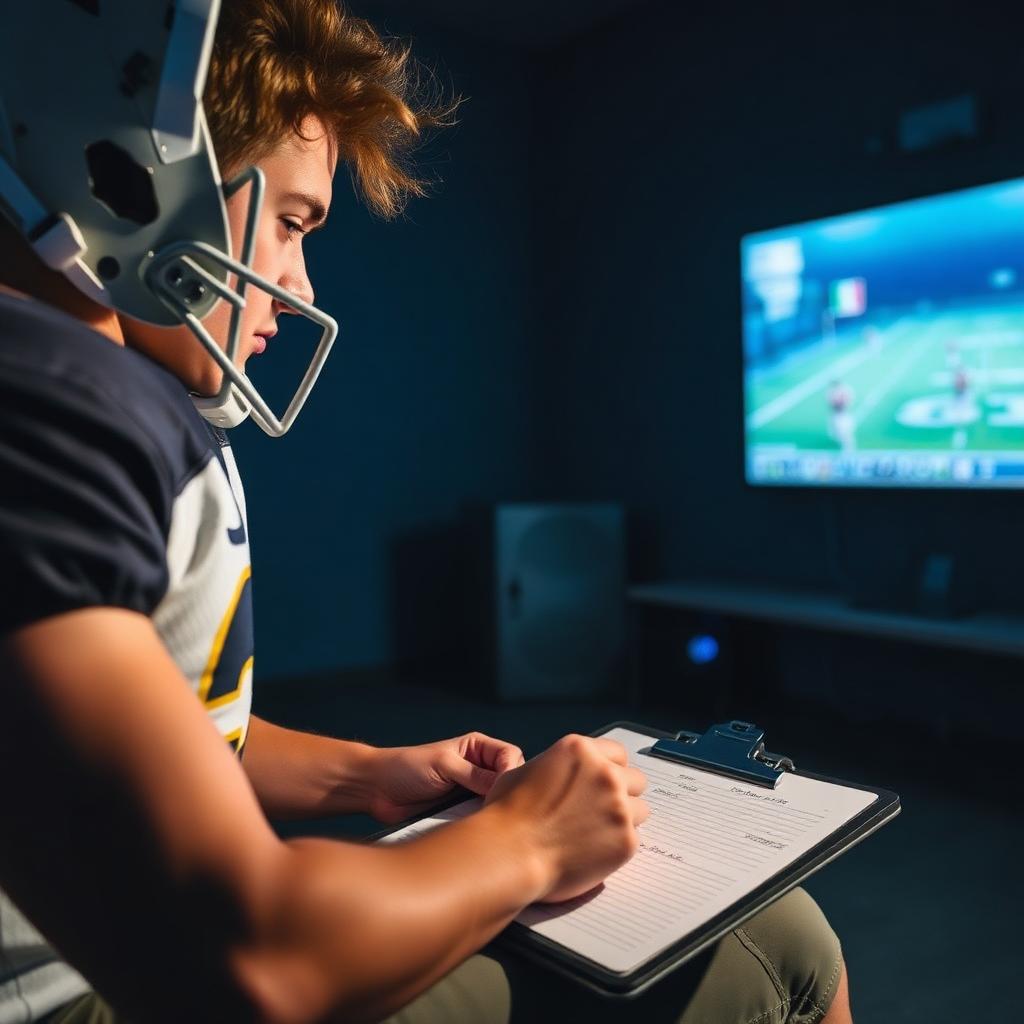
Set aside an hour. Get a notebook. Get a remote or your laptop. Pull up your most recent game film, not your highlight reel.
Watch the whole game one time at normal speed without taking notes. Just get a feel for the game.
Watch the game a second time, defensive snaps only. Pause after each snap. In your notebook, write the down, distance, formation, play call, your assignment, what you did, and the result. Be honest. If you got blocked, write "blocked." If you ran past the play, write "over-pursued."
Watch the game a third time, only the snaps where you wrote a problem. Slow it down. Frame by frame if you can. Find the specific moment where the rep went wrong. Was it your stance? Your first step? Your hand placement? Your eyes? Your pursuit angle?
You will find that your problems happen at the same moment, over and over. That's your fix list for the week.
What to look for at defensive end
Five categories of mistakes show up on defensive end film:
Stance: are you in the same stance every snap? Pads down, hips loaded, eyes on the V? If your stance changes when you're tired or when the score is uneven, fix it.
Get-off: are you firing on the snap or on the ball? Stopwatch your first step. If you're a half-tick late, you're losing reps before they start.
Hand placement: are your hands landing inside on the tackle's chest plate? Or are they landing on his shoulders, his arms, his helmet? Outside hands = locked out = lost rep.
Edge discipline: on run plays, are you keeping your outside shoulder free and forcing the ball back inside? Or are you crashing inside and giving up the bounce?
Pursuit: when the play breaks away from you, are you running flat or are you taking a proper pursuit angle? Lazy pursuit shows up on every coach's grade sheet.
Track patterns across games
One game's film is data. Five games of film is information. Twenty games of film is a coaching plan.
Keep a running log. Every game, note the situations where you struggled. After five or six games you will see patterns. "I get reach-blocked on every weak-side run when the back is in the slot." "I over-pursue on every play-action where the quarterback rolls out to my side." "I lose every one-on-one against a tackle who jump-sets me."
Those patterns are your priority list. Show them to your defensive line coach. Ask him to drill those specific situations in practice. You'll see those problems disappear within two or three weeks.
Watching the opponent
Half of your film study should be on yourself. The other half should be on your next opponent's offensive tackle. Pull up his last three games. Watch every pass-pro snap. Find his tells.
Does he false step inside on every pass play? Does his weight shift to his heels in his set? Does he kick wide on the snap or stay vertical? Does he punch with his left hand or his right hand? Does he panic against speed or against power?
You will know more about him in an hour of film than you'll learn in four quarters of the game. That hour is worth two extra sacks on Friday.
What to do with what you find
Film study is worth nothing if you don't change anything on Monday. Take your fix list from Sunday and bring it to the field on Monday. Tell your DL coach. Ask for individual reps that target your specific problems. Walk through corrections with a partner before practice.
The film-to-field loop — Sunday film, Monday correction, Tuesday rep, Wednesday refine, Friday execute — is the rhythm of every player who actually improves.
Tools that help
Hudl is the obvious one. Make sure you can slow film down to half-speed and frame-by-frame. Use the spotlight tool to mark your jersey on every snap. Use the comment feature to leave yourself notes on specific reps.
A simple stopwatch app on your phone, or the Hudl frame timer, can measure your get-off in tenths of a second. That's a real metric you can track week to week.
A notebook beats any digital tool for this work. Writing slows you down and forces you to think. Use a notebook.
The honest truth
You will hate watching your bad reps. It will feel like getting kicked in the chest every Sunday. That feeling is the feeling of getting better. Players who avoid that feeling stay the same player they were as freshmen. Players who lean into that feeling become the player coaches recruit.
Watch the bad reps. Find the patterns. Fix the patterns. Repeat every week for four years. That's the whole job.