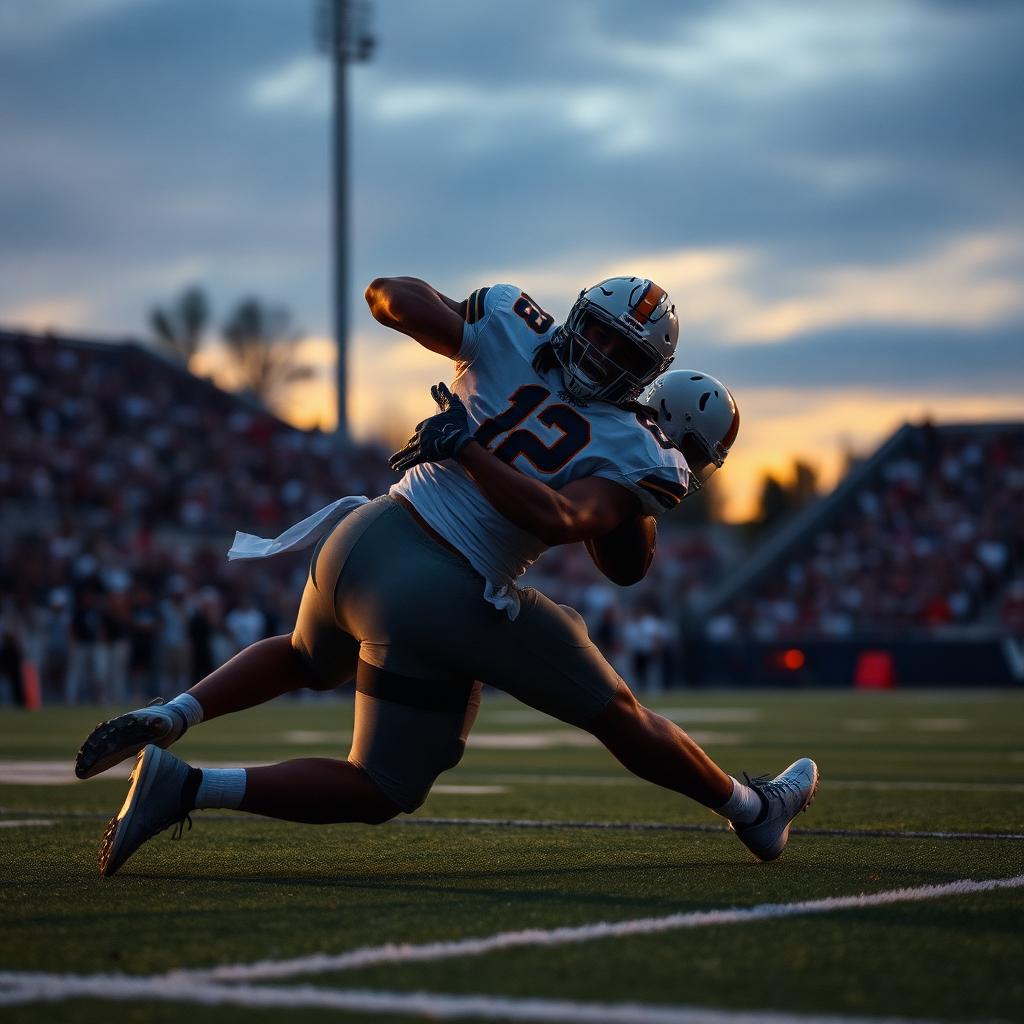
Rip Move Mechanics for Edge Rushers
The rip is the safest, most repeatable pass rush move in football. If you can rip clean, you can bend the edge, beat a tackle's set, and get home with two hands free.
If the bull rush is the foundation of a pass-rush plan and the swim is the high-risk counter, the rip is the bread and butter. The rip is the move that wins on volume. You will throw more rips in your career than any other move, and every great edge rusher in football has a rip he can hit in his sleep.
What the rip is
The rip is a get-around move. You're not trying to run through the tackle. You're trying to go past him by clearing his hands and dipping your near shoulder under his chest. The rip arm — your inside arm, the one closest to the offensive tackle's body — drives up violently through his armpit, throwing his outside arm into the air and clearing his hands away from your chest.
Done right, the rip looks like a vertical uppercut combined with a low dip and a turn. Your inside shoulder ends up below the tackle's chest, your eyes are on the quarterback, and his hands are over your head behind you. He literally can't grab you because his arms are in the wrong place.
Why it's so reliable
Three reasons. First, the rip works against any kind of set. If the tackle is in a deep pass set, you can rip around him. If he's in a quick set, you can rip through him. If he's run blocking, you can rip across his face. The geometry doesn't change.
Second, the rip keeps your hands free. After the rip, both of your hands are at your sides — ready to chase the quarterback, ready to attempt a strip-sack, ready to swat a screen. Compare that to the swim, where your over arm is out of position to make a tackle for half a tick after the move clears.
Third, the rip is safe. Your shoulder doesn't get exposed. Your ribs don't get exposed. The worst case is you don't get past the tackle and you end up in a stalemate. The worst case for a swim is you get punched in the ribs and you're on the ground.
How to throw it
Start with the same get-off you use for every move. Short first step, downhill, eyes on the V of the neck. The first quarter-second is identical to a bull rush.
As you arrive at contact, instead of punching through with both hands, do this: take your inside hand and drive it from your hip up through the tackle's armpit, palm facing up, like you're throwing an uppercut at the sky. At the same moment, dip your inside shoulder so it slides under his chest plate. Your head turns to look at the quarterback.
Your outside arm doesn't disappear. It locks under and across the tackle's body, almost like a wing, to control his torso while you bend the edge. Some coaches call this the "long arm" finish. It keeps the tackle from grabbing you after you've cleared.
The last piece is the dip. The rip is a low move. Your inside shoulder has to drop below the tackle's chest, which means your hips have to bend, which means your ankles and your hip mobility matter more here than in any other move. If you can't dip, you can't rip. You can only rip-and-die.
The dip drill
Bend training is the most undervalued part of pass rush development. Buy a flexibility band. Three times a week, do five minutes of ankle mobility — knee-to-wall stretches, ankle circles, calf raises off a step with a deep eccentric. Then do five minutes of hip flow — pigeon stretch, 90-90 transitions, deep cossack squats. This is unsexy and it will add two sacks to your season more reliably than any rep in the weight room.
Then drill the bend itself. Set a cone at the corner. Sprint in a three-point stance, dip your inside shoulder past the cone without touching it, and turn upfield. Reset. Do ten per side. The cone is the tackle's chest. If you knock it over, you didn't dip enough.
When to rip
You should rip on every long-yardage situation where the tackle is in a vertical pass set. You should rip when the tackle has a slow kick step. You should rip after you've established a hard bull rush threat earlier in the drive and the tackle is starting to over-set inside to stop the bull.
You shouldn't rip against a tackle who is reach-blocking on a run play — you'll get sealed inside and the back will bounce outside of you. You shouldn't rip on quick passes where the ball is out in 1.5 seconds — you won't have time to bend, dip, and chase. You shouldn't rip if you haven't shown a bull rush yet, because the tackle will sit on it.
The shortcut
The rip is the move that pays back the most film study and the least raw athleticism. A 4.9 forty defensive end with a great rip move will out-produce a 4.7 with no rip every Friday night. You can build this move in a backyard. Build it.