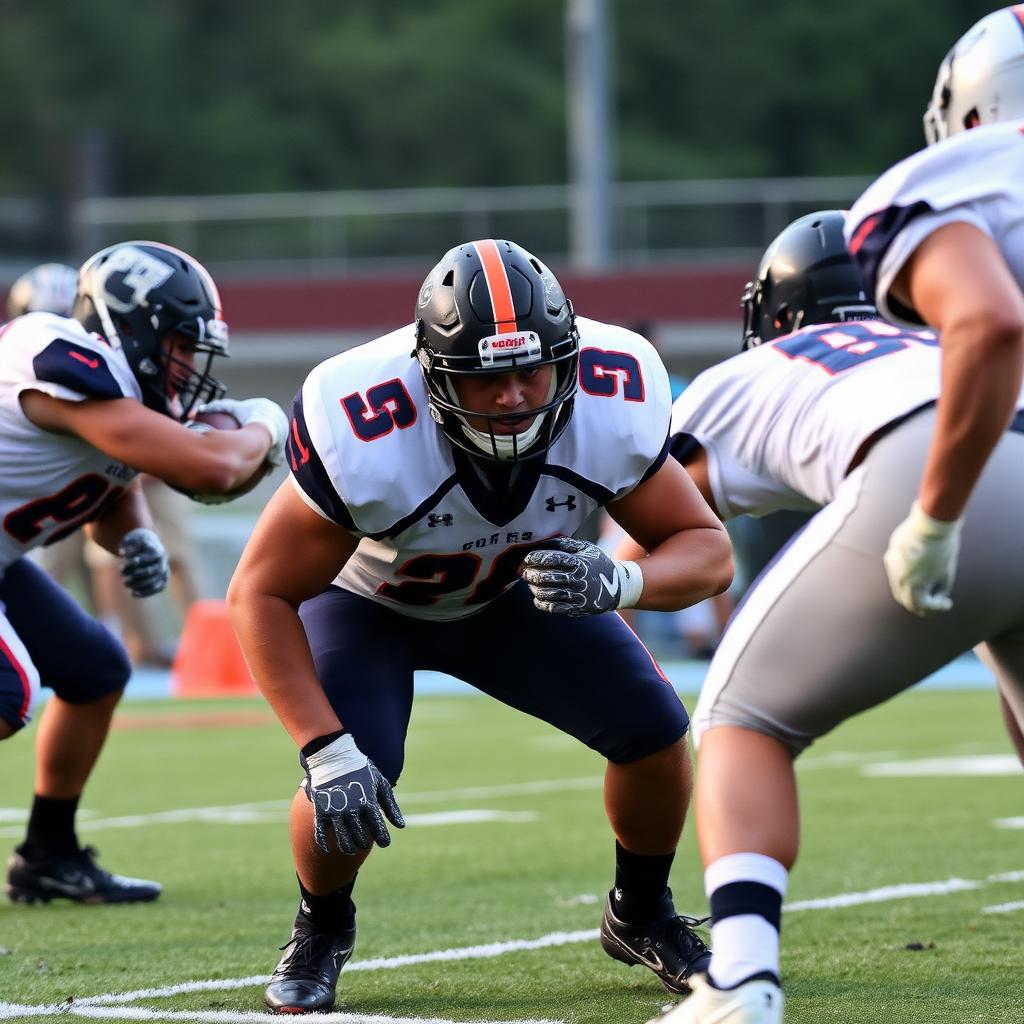
Setting the Edge Against the Run
Pass rush is the highlight reel. Setting the edge is the job. Here's how to force every outside run back inside, where your linebackers can clean it up.
Every recruiting site, every YouTube highlight, every Twitter clip celebrates pass rushers. Sacks get the likes. But ask any college position coach what gets a defensive end on the field as a freshman, and they will tell you the same thing: he has to set the edge. If you can't be trusted on first down to force the ball back inside, you don't play. Doesn't matter how many sacks you had in high school.
What "setting the edge" means
The edge of the defense is the boundary that separates inside runs from outside runs. Your job, as a defensive end, is to make sure no offensive ball-carrier crosses your outside shoulder going forward. Anything that bounces outside of you is a touchdown waiting to happen. Anything that you funnel back inside dies in the pile.
So when an offensive tackle blocks down on the defensive tackle and a pulling guard or tight end comes at you, your job is not to get upfield. Your job is to take on the blocker, hold your ground, and turn the play back inside. You are the wall.
The keys
Three keys to setting the edge: pad level, leverage, and feet.
Pad level: the same rule as pass rush. You have to be lower than the blocker. If a 250-pound pulling guard arrives at you with his pads at your sternum, you lose. Drop your hips, drop your shoulders, and meet him with your facemask at his chest.
Leverage: your outside arm is free, your inside arm is engaged. You want your outside shoulder, outside arm, and outside leg to be free of the block so you can shed inside. The inside arm — and specifically the inside hand — punches into the blocker's near shoulder and locks out, creating separation between his body and yours.
Feet: never cross your feet, and never go backwards. You shuffle. Your stance widens. You take small, choppy steps that keep your base under you. The instant you cross your feet, the blocker gets your hips turned and the back bounces outside.
The wrong way: getting up the field
The most common mistake young defensive ends make is exploding upfield on every snap because that's what works in pass rush. On a run play to your side, getting upfield is a disaster. The pulling guard kicks you out, the back bends underneath you, and you watch from four yards behind the line as he runs for a first down.
Discipline. On every snap, your first read isn't "pass rush." Your first read is "high hat / low hat." If the tackle's helmet rises, it's pass and you go. If the tackle's helmet stays low or drops, it's run and you set. You make that read in the first step, before you commit to a rush plan.
Reading the block
You will see four kinds of blocks at the edge. Each one has a counter.
A reach block — the tackle tries to get his head outside your outside shoulder. Counter: rip your outside arm through, plant your outside foot, and stay outside. Don't let his head cross your face.
A down block — the tackle blocks inside on your defensive tackle. Counter: this is a pulling guard or kick-out coming for you. Reset your feet wider, brace your inside shoulder, deliver a blow with your inside hand, and turn the play back inside.
A double-team — the tackle and tight end both hit you. Counter: drop your weight, get small, and split the seam. You won't make the tackle on this play but you can't let the back bounce off your back hip.
A pull-and-trap — the tackle leaves you, a guard comes from the inside to kick you out. Counter: wrong-arm. Drop your inside shoulder under his pads and spill the play to the linebacker behind you. This is an advanced technique — drill it with your coach before you try it on Friday night.
Hands beat hands
Setting the edge is a hand-fight, exactly like pass rush. The defensive end who lands his hands first wins the rep. Practice your independent hand strikes — a punch with the inside hand to control, a club with the outside hand to shed. Most defensive ends throw both hands at the same time because that's what feels strong. Independent hands win edge plays.
The mental piece
Setting the edge requires you to give up the highlight in order to do your job. The back runs inside, your linebacker makes the tackle, and your tape just shows you holding a block. No sack, no TFL, nothing for Twitter. But the college coach scouting you knows exactly what just happened — and he knows you can play.
How to drill it
Get a partner. Both of you in stances. He's a tight end at your outside shoulder. On the snap, he tries to reach you. You strike with your inside hand, keep your outside shoulder free, shuffle outside, and force him to give up the leverage. Reset. Then he runs a down block — he turns inside — and a coach with a hand shield simulates the pulling guard coming at you. You reset, square up, and stuff the trap.
Do this every day in spring ball. The kids who do this every day are the kids who play as sophomores.